KAY
Wednesday, March 31, 2010
I'm a Sarah Dessen expert now
Hey, pals. So I just finished this book by Sarah Dessen. It was the only one of hers I had yet to read, and now I have read her entire collection, which is a little nerdy, but also makes me really happy. For a more general review of Sarah Dessen books, read my review of "Along for the Ride" here. In this book, 15-year-old Haven longs for summers past, specifically the summer when her sister Ashley was dating the fun, charming Sumner. Now, Ashley's getting married to a boring guy named Lewis, her family's falling apart after her parents divorce and her father's marriage to his mistress, and Haven has just about had it. That's when Sumner shows up again, making Haven long for the past even more. This definitely wasn't my favorite Sarah Dessen book (you can see how her writing matures in her later books), but it was still a really nice short spring break read, and I liked that the ending wasn't picture perfect. I give it 7.5 pretzel bites.
Monday, March 29, 2010
I don't want to be a freshman all over again
This book is a memoir by Zoe Trope about her freshman and sophomore years in high school, about falling in love, about being gay, about getting a book deal, about feeling misunderstood. I first picked it up because someone told me that something I wrote reminded them of this book. It was meant as in, "The writing and characters are really good, but the public won't like it because there's no plot." So, of course, I had to be self-centered and go read the book that was supposedly like mine. The first thing I discovered, before I even started reading, was that on the cover there are comments from DAVE EGGERS and JONATHAN SAFRAN FOER saying how genius it is. If Dave Eggers and Jonathan Safran Foer loved something I'd written, I'm pretty sure I wouldn't care if the public did or not.
So yes. There's not really a plot. That didn't really bother me. It took me a little while to get into it, because a lot of times it's written kind of like poetry. It can be very cryptic. At first, I found the author irritating. Then, however, I hit a point where I couldn't put it down. I just wanted to keep reading. I still found it irritating in places, but it was just so beautifully written. There were several lines I had to reread multiple times because they were just phrased so perfectly. This book is definitely not for everyone, but overall it is a truly lovely piece of work. 7.5 pretzel bites.
KAY
Monday, March 15, 2010
Guess who's behind the times again?
So, by this point, practically everyone's heard of this book by Audrey Niffenegger. However, for a really long time I had the impression that it was about women being abused in ancient China, and that was never something I was in the mood to read. I know. I have no idea why I thought that. Then I saw the trailer for the movie (which apparently is horrible and I have no intention of seeing) and thought the concept seemed kind of interesting. For those of you who have been living under a rock like me and don't know what it's about, there's this guy named Henry who every now and then just disappears and travels through time involuntarily. Not like, oh wow, let's revisit Germany and try to stop Hitler, but like, to parts of his own past and whatnot. He's been visiting his wife Clare (who does not travel through time) ever since she was a child, so they've always known that they were meant to be together, and the book is the tale of their lives together. A lot of it takes place in Chicago, which was nice because I was familiar with a lot of the settings.
In the beginning, this book was really intriguing. The whole concept and logistics of time travel really interested me, and it was strange to think about because, when it really comes down to it, they only met because future Henry told past Clare they were supposed to, and then Clare grew up and met Henry in the present and told him, "Hey, we're supposed to be together." Interesting, right? It must have taken a lot of planning on the part of the author, too, to get all the chronology to match up. After a while, though, it got into all this drama where they were trying to have a kid, which was more boring for me, maybe because I can't relate. Then at the end, it got really intense out of nowhere. I didn't find the ending all that satisfying. I think I lost interest a little bit in the middle. Anyway, I give this book 7 pretzel bites.
KAY
Friday, February 19, 2010
The andromeda strain
So, yet another book by Michael Crichton. Guess what? I really like him. I swear I have learned more from him than all of my years of schooling. This book, The Andromeda Strain, is a classic. But I have to say, this is not one of my favorite books by him. Quite the contrary in fact, I think it may be my least favorite. For the sole reason it just seemed like he got tired of writing it and just ended it in the cleanest and quickest way possible. I believe he got sick of making up and researching obscure medical facts. Which I can't blame him for. I generally like the book, but, like I said, there were more serious medical and biological facts than I needed. In the final analysis Crichton writes a spellbinding novel with a seemingly real reality for all of his characters. So in concluion 8 pretzel bites.
TEE
Remember "The Lottery?"
This is a novel by Shirley Jackson, who's the woman who wrote that short story "The Lottery" that so many people seem to be assigned to read in school. This book is relatively short; only 146 pages. At the beginning of the novel, we are introduced to the narrator, Mary Katherine (a.k.a Merricat) who is 18 but seems much younger. She lives with her older sister, Constance, her invalid uncle, Julian, and her faithful cat, Jonas. The village people hate Merricat and Constance, and for the most part the pair hide out in their house. The rest of their family was murdered.
Parts of the story were intriguing, and one thing I liked about it was that it was a little vague in what time it was set. There was no fantasy element, yet everything in the story felt a bit fantastical. I also think Jackson did an excellent job with her characters; they felt complex. I enjoyed the book, but it didn't thoroughly grip me. There's was one point where I thought there was going to be a major twist, and then... there wasn't. There were also times when I felt as though something was being built up to, and then whatever it was wasn't as big as I'd expected. I give this book 7 pretzel bites.
KAY
Monday, February 8, 2010
Brooklyn, Brooklyn, take me in
Hmm. Let's see. How can I sum up what this novel (by Paul Auster) is about? It's not really about just one thing. It's about broken families, forgery, almost dying, actually dying, classic literature, and escape. That's a pretty nice collection of topics. However, I will start by saying that I found the narrator irritating. He was easily my least favorite of all the characters in the entire book. Perhaps because of this, I liked the shorter stories of the past within the main story better than the main story itself. I never found myself bored of the book. In fact, it was something I was often in the mood to read, and I enjoyed it while I was reading. That being said, I think it lost a little steam towards the end, and honestly, it failed to make much of an impression on me. I think, in the end, it just didn't make me feel much of anything. 7 pretzel bites
KAY
Sunday, January 31, 2010
Economics for people who don't like economics
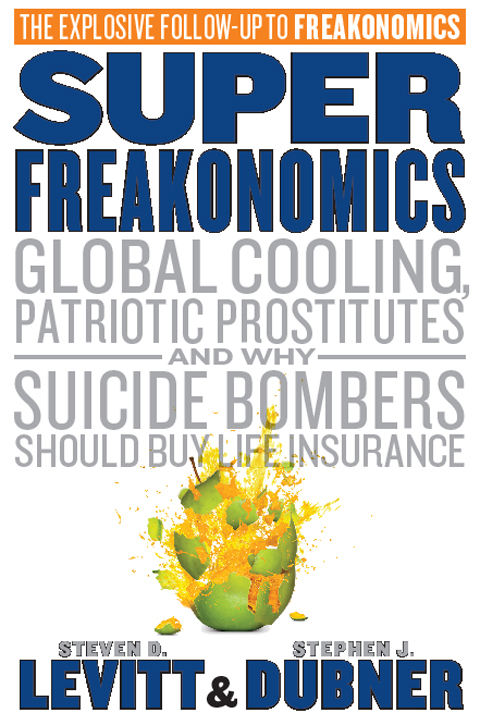
This is the second book written collaboratively by Steven Levitt and Stephen Dubner, the first being "Freakonomics." I've read both books now, and they're both really interesting. Both of them are nonfiction books that use economic principles to discuss everything from prostitution to global warming to monkeys. I think a lot of people shy away from the books because they hear "economics" and it makes them think "numbers hfdsuig stock market vasuigriutwt economy crash iothsgnsoet boringness," but that's not what the books are like at all. They use economic terms (externalities, incentives, etc.), but explain them in a way that even if you know nothing about economics, you can still get a lot out of the book. If you're looking to read a chapter just to get a feel for the book, I reccommend "Chapter 3: Unbelievable Stories About Apathy and Altruism." That one was my favorite.
What I really like about these books is that Levitt and Dubner get so much information in there without making you feel overloaded. Whenever I flipped back to look at something, I always went, "Oh yeah, I forgot about this part! Oh yeah, and that part, that was interesting too! Wow, there was so much stuff in this chapter!" I learned about some subjects I knew nothing about and, additionally, got a new take on some subjects I was more familiar with. I would say don't read the book for the hook questions they advertise with ("Why should suicide bombers buy life insurance?" for instance), because the answers to those are usually not so interesting, but the other information that accompanies those answers is fascinating. I don't have the greatest patience for non-fiction, so it wasn't exactly the kind of book I couldn't put down, and I definitely liked some sections more than others, but overall it was a really interesting book, and I reccommend it to economists and non-economists alike. 7.5 pretzel bites.
KAY
Subscribe to:
Posts (Atom)